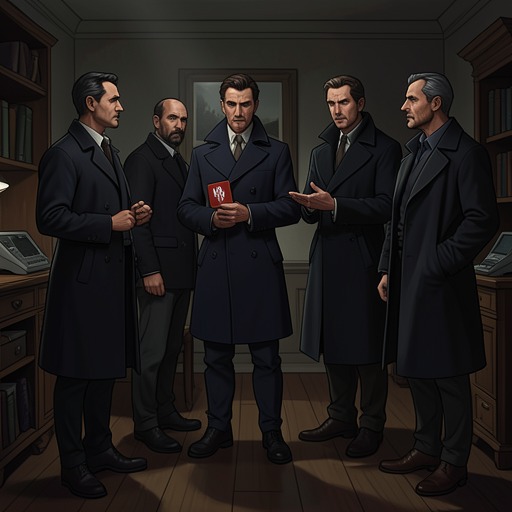
Hōtei Dōshikai attacked Anthony and attempted to seize the memoir
The Secret of ChimneysThe Comrades of the Red Hand raid is the first direct, armed challenge to Anthony Cade’s custody of Count Stylptitch’s memoirs. A stranger enters Cade’s room, identifies himself as a member of the revolutionary Brotherhood, and demands the manuscript; when Cade refuses, he produces a revolver. Cade knocks the weapon away and kicks the intruder into the corridor, where the would-be attacker gets up and flees. The encounter turns what Cade had expected to be a straightforward delivery into a dangerous contest over politically sensitive papers.
The intruder and his demand
The stranger appears in Cade’s doorway as a squat, sinister-looking man with a brutal head and an evil grin. His English is idiomatic despite a guttural, foreign voice. Cade tells him to leave and asks who allowed him upstairs; the intruder answers that he goes where he pleases. His eyes remain fixed on the packet of letters Cade has picked up, and he insists that he will not leave until Cade gives him what he came for.
Cade initially guesses that the visitor may have been sent by Baron Lolopretjzyl, whose name the stranger pronounces as a string of harsh consonants. The man vehemently denies the suggestion, even spitting to emphasize his rejection, and throws a paper onto the table. It bears a crude drawing of a human hand in red. The intruder identifies the mark as the sign of the Comrades of the Red Hand and declares himself one of them: the emblem makes the political affiliation explicit rather than leaving Cade to infer it from appearance or manner.
The demand becomes an armed confrontation
Having identified himself as a Comrade of the Red Hand, the intruder calls Cade a paid slave of an effete monarchy and promises that he may leave unhurt if he surrenders the memoirs. The offer is framed as the Brotherhood’s clemency, but Cade refuses: his instructions are to deliver the manuscript to a publishing firm, not to the revolutionary organization. The dispute therefore turns on custody of the politically compromising papers, with the two men claiming incompatible authority over their destination.
The stranger abandons persuasion and says Cade will never be allowed to reach the publisher alive. He draws a revolver and threatens to shoot unless the papers are handed over. Cade moves before the weapon can be brought to bear: he springs forward as it comes from the intruder’s pocket and knocks it from his hand. The blow turns the man around, exposing his back; Cade follows with a forceful kick that sends him through the doorway and into the corridor.
Cade steps out after him, but the attacker has had enough. He rises nimbly and runs down the passage, and Cade chooses not to pursue. The exchange ends not with the manuscript seized but with the intruder driven off, leaving Cade in possession of the papers and newly aware that the commission carries a physical danger he had not anticipated.
From attempted theft to repeated pressure
The raid also establishes a pattern that extends beyond the first armed visit: the manuscript and the related papers remain targets even when Cade takes precautions. After the confrontation, he gathers the letters and the manuscript’s wrapping, locks them in his suitcase, secures the room door, and braces it with a chair topped by a water bottle. He puts the manuscript under his pillow before falling asleep. Several hours later, a stealthy rustle wakes him; a dark figure is kneeling beside the suitcase. The intruder is Giuseppe, the waiter, who has a long, thin knife and attacks Cade. The shift from an openly declared revolutionary to a hotel worker moving secretly at night shows how the contest over the papers can exploit both force and access, and makes the initial raid the first sign of a wider threat rather than an isolated encounter.
A raid that exposes the larger danger
The first assault changes Cade’s understanding of his commission. He had assumed that delivering Count Stylptitch’s memoirs would be a comparatively easy errand; after the armed visitor is driven away, he recognizes that he has already antagonized both the Loyalists and the revolutionaries. He resolves to begin work on the manuscript that night, while taking precautions against further attempts to reach it. The danger is not abstract political disagreement: an organization has sent a man into his room, displayed its identifying emblem, and threatened his life over the papers.
Cade’s later account to Lord Caterham makes clear how the raid belongs to a chain of events in which his handling of evidence has itself become perilous. Within twenty-four hours, he has become entangled in two separate crimes: he has deliberately disposed of a body, then arrived at the scene of another crime as it was being committed. When he chooses to tell the truth, he plans one minor alteration and one grave suppression. The intruder’s threat thus foreshadows a broader problem: Cade is not merely protecting a manuscript from political factions but navigating a situation in which concealment, truthful disclosure, and the obstruction of justice have become difficult to separate.
The subsequent attempts to get at other papers and objects widen the pattern without proving that each intruder belongs to the Brotherhood. Giuseppe later attacks Cade at night beside the suitcase, and Cade eventually leaves the waiter’s body by the road between Hounslow and Staines, hiding the pistol high in a tree at Burnham Beeches. At Chimneys, a window is found unlatched after a crime, prompting competing possibilities about an intruder from outside or someone within the house. These later episodes turn the raid’s basic vulnerability—valuable papers can be pursued through access as well as open force—into a recurring structure of suspicion, entry, and compromised evidence.
The initial encounter nevertheless remains distinct in its clarity. The stranger names the Comrades of the Red Hand, displays their red hand mark, states the Brotherhood’s demand, and makes the threat explicit before Cade defeats him in a direct physical struggle. Later investigations depend on withheld facts and uncertain evidence; here, the political claimant identifies himself plainly, only to be repelled. That contrast makes the raid an early declaration of the book’s central contest over who controls the memoirs—and over whether Cade can carry out his commission without becoming implicated in the crimes that gather around it.